
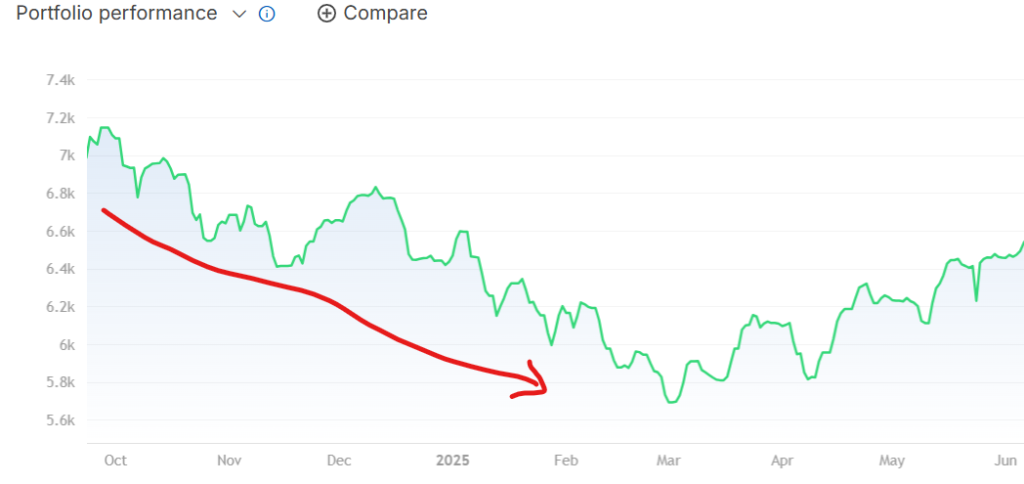
If you have been holding a portfolio in mutual funds or stocks, you’ve likely felt the pain of recent market corrections. Since the market peak back in October 2024, we’ve seen quite a few painful drawdowns—some dragging portfolios down by as much as 15-20%.
Watching your portfolio bleed value over time is frustrating. You rarely see massive single-day wipeouts; instead, it’s a slow bleed. You might see a negative ₹10,000 PnL one day, followed by a negative ₹5,000 the next. While these daily drops seem small, they compound significantly over a 3-month scale.
So, how do we avoid the worst of this drawdown and generate extra passive income while we wait for the market to recover?
The answer: A Hedged Covered Call Strategy.
The Core Concept
A traditional covered call involves holding a stock or ETF and selling a Call option against it to collect a premium. If the market stays flat or drops, you keep the premium, which softens the blow of your portfolio dropping.
However, to protect against unlimited risk on the upside, we are going to use a hedged variation (essentially a Bear Call Spread paired with your portfolio).
Let’s walk through a simple Excel simulation using data as of May 19, 2026.
The Setup
Imagine you have a ₹15 Lakh portfolio invested in index funds, Nifty BeES, or stocks. For simplicity, let’s assume your portfolio’s beta is 1—meaning if the Nifty moves by 1%, your portfolio moves by exactly 1%.
We are looking at the June expiry, which is roughly 40 days (or 6 weeks) away. Our simulation tests various Nifty spot price scenarios ranging from a bearish 20,000 all the way up to a bullish 28,000.
The Options Trade
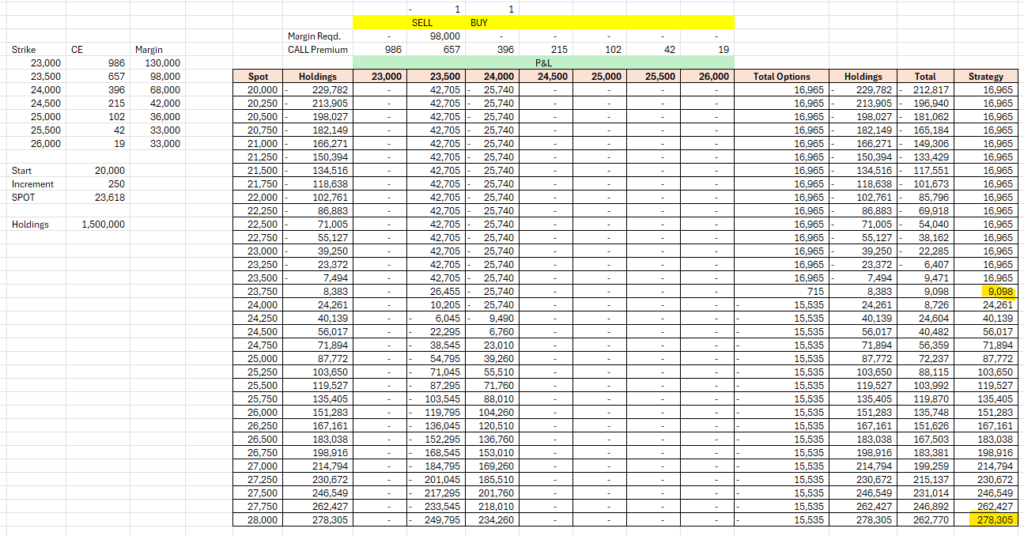
To execute this, we look at the option chain. Here is our setup:
- SELL the 23,500 CE (Call Option) to collect a premium of roughly ₹657.
- BUY the 24,000 CE (Call Option) for roughly ₹396 to cap our upside risk.
Note: Buying the 24,000 CE is our insurance policy. It protects us from catastrophic losses in case the market suddenly shoots up.
Scenario Analysis: Profit & Loss (PnL)
Let’s look at the PnL of this combined strategy across different market scenarios at expiry:
Scenario 1: The Market Crashes (Nifty falls to 20,000) If the Nifty crashes to 20,000, your core portfolio will take a hit (resulting in an unrealized loss of about ₹2.29 Lakhs). However, your options strategy will expire perfectly in your favor. You keep the net premium collected, resulting in a realized profit of ₹16,965. This cash flow helps cushion the blow of the market drop.
Scenario 2: The Market Rallies (Nifty rises to 25,000 – 28,000) If the Nifty shoots up significantly, your options strategy will hit its maximum capped loss. In our simulation, the options trade will result in a net loss of -₹15,535. But don’t panic! Because the Nifty rallied, your ₹15 Lakh core holdings increased significantly in value. For example, at 25,000, your portfolio might be up by over ₹81,000. The massive gains in your equity portfolio easily absorb the minor ₹15,535 loss from the options hedge, giving you a net +67k. Now you can:
1) You can comfortably square off your positions and walk away with a net positive gain.
2) Or you can place GTT orders to book profits at say net +50k and continue the strategy for the next month.
The Net Strategy PnL
The beauty of this strategy is the payoff graph. Over a massive spot range of 20,000 to 28,000, the P&L remains incredibly resilient. Because you are dynamically offsetting portfolio drops with option premiums, and offsetting option losses with portfolio gains, the overall strategy yields positive values ranging from ₹9,000 up to over ₹2 Lakhs depending on the market direction.
If the market crashes, you treat the ₹16,900 options payout as pure passive income while you wait out the dip. If the market rallies, you enjoy the core capital appreciation minus the small defined options loss.
Capital and Margin Requirements
This strategy is highly capital efficient for someone who already holds an idle mutual fund or stock portfolio.
- Pledge Your Assets: You can pledge your existing stocks or mutual funds to get the margin required to sell the options.
- Cash Buffer: You will only need to bring in additional cash margin to cover the exchange requirements and daily Mark-to-Market (MTM) fluctuations.
- Execution: For a trade that requires around ₹98,000 to ₹1.3 Lakhs in margin, having a liquid cash buffer of about ₹2 Lakhs in your account allows you to easily hold the positions without sweating the daily volatility spikes.
The Best Part? It’s Pure Simple Math.
- No Black-Box AI Tools: There are no complex algorithms or hidden artificial intelligence tools used to develop this strategy. It is built entirely on simple math and basic Excel modeling!
- Low Time Commitment: You don’t need to spend hours sitting in front of a computer screen watching the ticker tick. Once you analyze your parameters and enter the trade, checking in and monitoring it just once a week is more than sufficient.
- Highly Adaptable: While we used Nifty options for this example, the same philosophy can easily be extended to other liquid assets—whether you hold NiftyBeES, GoldBeES, individual high-volume stocks, or a diversified portfolio of multiple stocks.
Leveling Up: Optimizing the Strategy
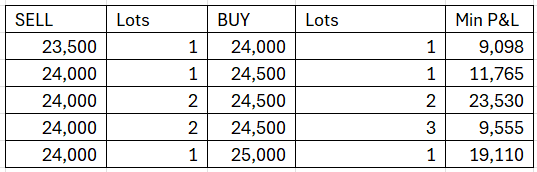
The example above is just the beginning. By playing with the math in Excel, you can optimize your combinations to maximize the minimum PnL across the entire curve. You can do this by:
- Shifting Strikes: Testing different pairs, like selling the 24,500 CE and buying the 25,000 CE.
- Scaling Up: Increasing your position to two or three lots depending on your portfolio size.
- Ratio Spreads: Creating asymmetric risk profiles by altering the ratio of your legs (e.g., 2 Buy legs for every 1 Sell leg, or 3 Buys for every 2 Sells).
Want to Learn More?
We will be hosting a brief information session on how to set this up step-by-step in the near future. If you are interested in learning how to manage your own hedged covered calls, click below to join our community group: 👉 [Link to WhatsApp Group] / [Telegram Group]
More QnA here at this link – https://niftybanknifty.com/question/hedged-covered-call-strategy/
Disclaimer: This site and its contributors are neither SEBI-registered Equity Research Analysts nor Investment Advisers. The strategies and opinions expressed here are solely for educational purposes, personal trading insights, or shared out of a passionate interest in the stock markets. This site and its contributors are not responsible for any profits or losses arising from any information, post, or opinion shared here. Investors are strongly advised to conduct their own due diligence and/or consult a certified financial adviser before making any market decisions.